









Ich Treatment Guide for Aquariums & Koi Ponds
If your fish suddenly look like they’re covered in tiny white grains of salt, you’re most likely dealing with ich - one of the most common and fast-spreading fish diseases in aquariums and koi ponds.
It usually starts small. A couple of spots, maybe some flashing or rubbing. But within days, it can spread across your entire system and put serious stress on your fish.
We see this all the time - people wait too long, try random treatments, or dose once and expect it to disappear. That’s not how ich works.
This guide breaks everything down in a simple, real-world way so you can actually fix the problem:
- What ich really is (and why it spreads so fast)
- Early warning signs before it gets out of control
- How the ich life cycle works (this is the key part)
- How to use Ich-X correctly in aquariums
- How to treat koi ponds safely
- Exact dosing with calculators - no guessing
If you follow this properly, you won’t just treat ich - you’ll actually get rid of it and prevent it from coming back.
Quick Answer: How to Treat Ich with Ich-X
- What is ich? A fast-spreading parasite that causes white spots on fish (often called white spot disease).
- Does Ich-X work? Yes - Ich-X is one of the most effective treatments when used correctly and consistently.
- Aquarium dosage: 5 mL per 10 gallons (or 1 tsp per 10 gallons), once every 24 hours.
- Pond dosage: 5 mL per 50 gallons (or 1 tsp per 50 gallons), once every 24 hours.
- Before dosing: Do at least a 25–30% water change and remove carbon from filters.
- How long to treat: Continue daily dosing for at least 3 days after all visible white spots are gone.
- Biggest mistake: Stopping treatment too early - this is why ich comes back.
Early Signs of Ich (Before the White Spots Show Up)
Most people only notice ich once the white spots appear. But by that point, the parasite has already been in your system for days.
If you catch it early, treatment is much easier and your fish go through a lot less stress.
Here are the early warning signs to watch for:
- Flashing or rubbing - fish scraping against rocks, gravel, or walls
- Clamped fins - fins held tight against the body instead of relaxed
- Unusual hiding or isolation - fish staying away from others or acting withdrawn
- Reduced appetite - eating less or ignoring food completely
- Sluggish movement - less active than normal, hovering in place
- Rapid breathing - gill movement is faster than usual (especially dangerous)
- Hanging near water flow - fish staying near returns, air stones, or waterfalls
In many cases, especially in koi ponds, ich can affect the gills before you even see spots on the body. That’s why fish may look stressed or breathe heavily before anything visible shows up.
If you’re seeing a combination of these symptoms, don’t wait for the white spots - start preparing for treatment.
The Ich Life Cycle (Why One Dose Never Works)
This is the part most people don’t understand - and it’s exactly why ich keeps coming back.
Ich isn’t just “white spots on fish.” It’s a parasite that goes through multiple stages, and treatment only works during one of them.
Most treatments fail because people don’t understand this part.

1. Trophont (On the Fish)
This is what you see as white spots. The parasite is embedded in the fish and protected from treatment.
2. Tomont (Reproduction Stage)
The parasite drops off, forms a cyst, and multiplies - releasing dozens or even hundreds of new parasites.
3. Theront (Free-Swimming)
This is the only stage where treatment works. The parasite is in the water searching for a host.
Key Takeaway: You’re not treating the spots - you’re breaking the cycle over multiple days.
Why This Matters for Treatment
You’re not just treating the spots you see - you’re trying to break the entire cycle.
- White spots disappear → doesn’t mean the parasite is gone
- New parasites are still developing in the system
- Stopping treatment too early → outbreak comes back
This is why proper treatment always continues for several days after visible signs are gone.
The goal isn’t to remove the spots - it’s to eliminate every stage of the parasite over time.
Why Water Temperature Changes Everything
Water temperature directly controls how fast ich spreads - and how long treatment will take.
🔥 Warmer Water = Faster Cycle
At around 75–79°F (24–26°C), ich can complete its cycle in just a few days.
- Parasites reproduce faster
- More parasites enter the water sooner
- Treatment works faster (if consistent)
❄️ Colder Water = Longer Problem
In cooler conditions, the cycle slows - but treatment takes longer.
- Parasites stay protected longer
- Fewer are exposed at once
- More days of treatment required
What this means: Warm tanks treat faster. Cold ponds take longer. Either way - one or two doses is never enough.
What Is Ich-X (And Why It Works)
Ich-X targets ich at the only stage where treatment actually works - when the parasite is free-swimming in the water.
What It Treats
- Ich (white spot disease)
- Velvet (gold dust disease)
- Trichodina and other external parasites
Why It Works
- Targets the free-swimming stage
- Works quickly with consistent dosing
- Safe for most freshwater fish
- Can be used in aquariums and ponds
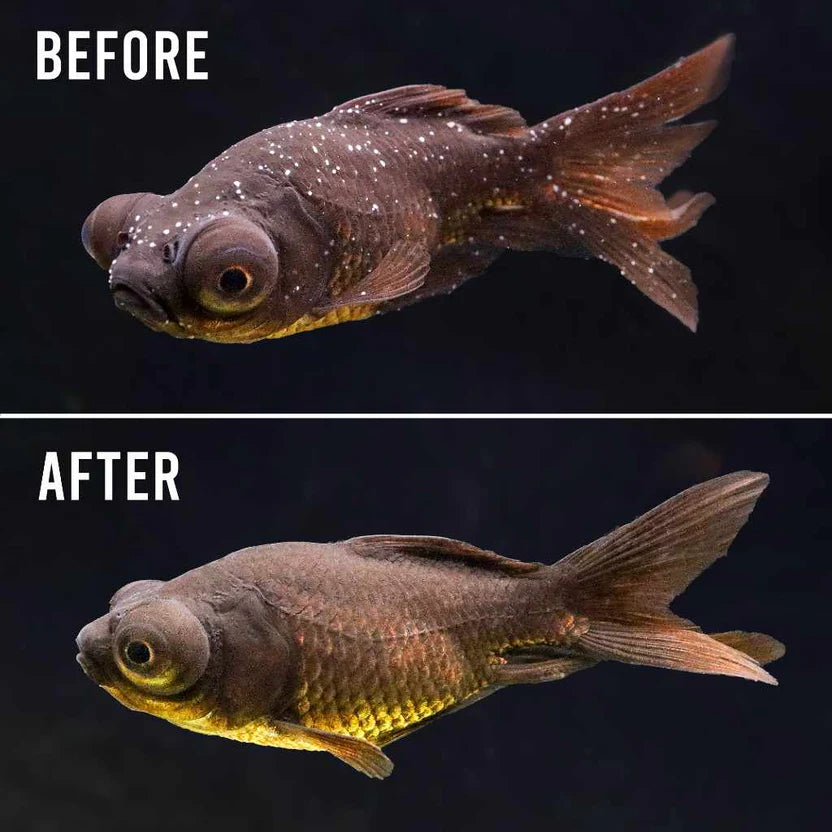
What makes it different: Ich-X doesn’t just reduce symptoms - it breaks the parasite cycle when used consistently over multiple days.
How to Use Ich-X in Aquariums (Step-by-Step Dosing Guide)
If you’re treating ich in an aquarium, accuracy matters. Underdosing won’t fix the problem - and overdosing can stress your fish.
The goal isn’t just to remove the white spots you see - it’s to break the parasite cycle completely. That means consistent dosing over multiple days.
Ich-X Aquarium Calculator
Enter your aquarium volume in gallons to see the exact dose per treatment and the best bottle size to buy.
Auto-updating
Standard dosage: 5 mL per 10 gallons · 5-day treatment estimate
Per Dose
-
mL
Per Dose
-
teaspoons
Per Dose
-
fl oz
Estimated 5-Day Total
-
fl oz
Bottle recommendation will appear here.
Shop Ich-X
Before You Dose
Remove any activated carbon from your filter and turn off UV sterilizers if you have them. These will remove the medication from the water and make treatment ineffective.
Before each dose, perform a 25-30% water change. This helps reduce parasite load in the water and keeps conditions stable for your fish.
How Much to Dose
5 mL per 10 gallons (or 1 teaspoon per 10 gallons).
Measure accurately - guessing is a common reason treatments fail.
How Often to Dose
Once every 24 hours.
This ensures you catch each new wave of parasites in the water.
How Long to Continue
At least 3 days after spots disappear.
Stopping early is the main reason ich comes back.
Common mistake: Stopping treatment as soon as fish look better. Visible spots disappear before the parasite is actually gone.
Important Tips
- Increase aeration - treatments can slightly reduce oxygen levels
- Do not mix Ich-X with other medications or salt
- Watch fish closely for signs of stress
- If fish react poorly, perform a large water change immediately
Pro tip: If your fish improve after 2 days, you’re not done - you’re about halfway through the treatment cycle.
Consistency is everything. Missing doses or stopping early resets the entire process.
How to Use Ich-X in Koi Ponds (Step-by-Step Guide)
Treating ich in a pond is different from an aquarium. Larger water volume, organic load, and temperature swings make consistency even more important.
If you get the dosing wrong in a pond, the treatment simply won’t work.
Ich-X Pond Calculator
Enter your pond volume in gallons to see the exact dose per treatment and the best bottle size to buy.
Auto-updating
Standard dosage: 5 mL per 50 gallons · Based on a 5-day treatment
Per Dose
-
mL
Per Dose
-
teaspoons
Per Dose
-
fl oz
Estimated 5-Day Total
-
fl oz
Bottle recommendation will appear here.
Shop Ich-X
Before You Start
Estimate your pond volume as accurately as possible. Underdosing is the #1 reason pond treatments fail.
Before starting and before each re-dose, perform a 25-30% water change to reduce parasite load and improve water quality.
How Much to Dose
5 mL per 50 gallons (or 1 teaspoon per 50 gallons).
Pond volume errors = underdosing = treatment failure.
How Often to Dose
Every 24 hours.
You need consistent dosing to catch each new parasite cycle.
How Long to Continue
At least 3 days after symptoms disappear.
Clear water doesn’t mean the parasite is gone.
Common mistake: Underdosing large ponds. Even small volume miscalculations can make treatment ineffective.
Important Tips for Pond Treatment
- Increase aeration - especially in warmer weather
- Do not use with salt or other treatments
- Watch koi closely for stress (especially in heavily stocked ponds)
- Stay consistent - skipping doses resets the cycle
Most pond treatments fail because of underdosing, inconsistent dosing, or stopping too early.
Common Mistakes When Treating Ich (And Why It Comes Back)
Most ich treatments don’t fail because the product doesn’t work they fail because of how it’s used.
If you’ve ever treated ich and it came back a few days later, chances are one of these happened:
Stopping Treatment Too Early
This is the #1 mistake.
The white spots disappear, fish look better and treatment stops. But the parasite is still in the system.
If you don’t continue for at least 3 days after visible signs are gone, ich will come back.
Underdosing
Guessing your water volume or “playing it safe” with a smaller dose doesn’t work.
If the concentration is too low, you’re not killing the parasite - you’re just slowing it down.
Skipping Water Changes
Water changes aren’t optional. They help remove parasites and keep water conditions stable during treatment.
Skipping them reduces the effectiveness of every dose.
Leaving Carbon in the Filter
Activated carbon removes medication from the water.
If you leave it in, you’re basically dosing and filtering the treatment out at the same time.
Mixing Treatments
Combining Ich-X with other medications or salt can cause stress or unexpected reactions.
Stick to one treatment plan unless you know exactly what you’re doing.
Only Treating Once
Ich has a life cycle - one dose won’t catch every stage.
You need repeated dosing to eliminate each wave of parasites as they become vulnerable.
Misdiagnosing the Problem
Not every white spot is ich.
Velvet, epistylis, and other conditions can look similar - but require different approaches.
If treatment isn’t working at all, it’s worth double-checking the diagnosis.
Bottom line: Ich comes back when the treatment isn’t completed properly - not because the treatment doesn’t work.
How Long Does Ich-X Take to Work?
This is one of the most common questions - and the answer depends on how the parasite cycle is progressing in your system.
Ich-X starts working as soon as it’s in the water, but you won’t see instant results.
What to Expect During Treatment
- Day 1-2: Fish may still show white spots and symptoms
- Day 2-4: Spots may begin to disappear as parasites leave the fish
- Day 3-6+: New parasites are still being released into the water
This is why treatment must continue even when your fish start looking better.
Typical Treatment Duration
- Most cases take 4 to 7 days of consistent dosing
- Colder water (ponds) may require longer treatment periods
- Always continue for at least 3 days after visible signs are gone
Important: The goal isn’t to remove the spots - it’s to eliminate the parasite from the entire system.
Why the spots disappear before the problem is gone: The visible white spots are only one stage of the parasite. When they drop off the fish, it can look like the problem is solved - but in reality, the parasite is multiplying in the system. If you stop treatment at this point, the next wave will infect your fish again.
When White Spots Are NOT Ich
Not every white spot on a fish is ich.
This is one of the biggest reasons treatments sometimes “don’t work” - the problem was misdiagnosed from the start.
Before you keep dosing, it’s worth making sure you’re actually dealing with ich.
Ich (White Spot Disease)
- Looks like small grains of salt
- Usually spreads across the body and fins
- Fish often flash, rub, and show irritation
- Spreads quickly to other fish
Velvet (Gold Dust Disease)
- Very fine, dust-like coating (often yellow or gold)
- Fish may look “cloudy” instead of spotted
- Heavy breathing is common
- Can progress even faster than ich
Epistylis
- White patches that look raised or fuzzy
- Often mistaken for ich but usually linked to bacterial issues
- Fish may appear lethargic and stressed
Lymphocystis
- Cauliflower-like growths (larger than ich spots)
- Typically appears on fins
- Does not spread the same way ich does
Sand, Air Bubbles, or Debris
- Small particles stuck to slime coat
- Often disappear quickly
- No change in fish behavior
Why this matters: If you’re treating the wrong problem, no medication will give you results.
Important: Ich-X is highly effective for ich and certain external parasites - but it won’t fix every condition that looks similar. If symptoms don’t improve after several days of proper dosing, it’s worth re-evaluating what you’re dealing with.
Can You Use Ich-X with Salt, Plants, Shrimp, and Snails?
This is where a lot of people get confused - and sometimes get into trouble by mixing things that shouldn’t be combined.
Here’s how Ich-X behaves in real-world setups:
Can You Use Ich-X with Salt?
No - do not combine Ich-X with salt.
Using both together can increase stress on fish and lead to unpredictable reactions. Stick to one treatment method at a time.
Is Ich-X Safe for Aquarium Plants?
In most cases, yes.
Ich-X is generally safe for live plants when used as directed. However, sensitive or delicate species may react differently, so it’s always a good idea to monitor your plants during treatment.
Is Ich-X Safe for Shrimp and Snails?
Ich-X can be used in systems with invertebrates like shrimp, crayfish, and snails - but with caution.
- Watch closely after dosing
- Remove immediately if you notice unusual behavior
- Sensitive species may react differently
Can You Use Ich-X with Other Medications?
No - avoid mixing Ich-X with other treatments.
Combining medications can cause stress, reduce effectiveness, or create unexpected chemical reactions in the water.
What about heat? Raising water temperature can speed up the ich life cycle, which may help the treatment work faster. However, this should only be done if your fish species can safely tolerate higher temperatures. Sudden or excessive temperature changes can cause more harm than good.
Bottom line: Keep it simple. Use Ich-X on its own, follow the dosing schedule, and monitor your fish closely. Mixing treatments usually creates more problems than it solves.
How to Prevent Ich from Coming Back
Treating ich is one thing. Preventing it from coming back is what actually saves you time, money, and fish.
Most outbreaks don’t come out of nowhere - they’re introduced into the system.
Quarantine New Fish
This is the most effective way to prevent ich.
Any new fish can carry parasites, even if they look healthy. A simple quarantine setup for 2–3 weeks can save your entire tank or pond.
Be Careful with Plants and Decorations
Ich can enter your system through plants, rocks, gravel, or equipment moved from another tank or pond.
Always rinse and isolate new additions when possible.
Avoid Sharing Equipment
Nets, buckets, hoses, and tools can transfer parasites between systems.
If you’re working with multiple tanks or ponds, keep equipment separate or disinfect it between uses.
Maintain Stable Water Conditions
Fish under stress are more vulnerable to disease.
Keep your water parameters stable, avoid sudden changes, and maintain proper filtration and aeration.
Don’t Overcrowd
High stocking levels increase stress and make it easier for parasites to spread quickly.
Give your fish enough space to stay healthy.
Watch for Early Signs
The earlier you catch ich, the easier it is to treat.
Pay attention to behavior - flashing, reduced appetite, and unusual movement are often the first warning signs.
Bottom line: Most ich outbreaks can be prevented with simple habits. A little extra caution upfront saves a lot of trouble later.
Final Thoughts: Treat It Right the First Time
Ich is one of those problems that looks small at first - and then escalates fast.
Most fish losses don’t happen because ich is impossible to treat. They happen because treatment starts too late, stops too early, or isn’t done consistently.
- Don’t wait once you see the signs
- Follow the full treatment cycle
- Keep dosing even after the spots are gone
When used properly, Ich-X is a reliable way to break the ich life cycle and clear your system.
Take your time, follow the steps, and you’ll get through it without losing fish.
If you’re not sure about your dosage or setup, it’s always better to double-check than guess.
Tags: